There’s a moment in almost every architecture review where someone puts up a slide with a Bronze, Silver and Gold layers, or a tiering model with tidy boxes labelled Data Products, and I watch the room nod along without actually agreeing to anything. The numbers are right. The logic holds. And still, nothing moves.
I used to think that was a communication problem. Explain it better, add a diagram, simplify the language. I’ve stopped believing that.
What I Thought Would Convince People
For years my instinct in these conversations was the same: get the model right, and the model will do the convincing. If the medallion layers are rationalised cleanly, if the tiering makes sense on paper, people will follow the logic to the same conclusion I had. That’s how I was trained to think, and honestly, it’s how most of us in this line of work are trained to think.
Analysis first. Persuasion is just analysis, presented well.
I was reading Steven Johnson’s Farsighted a few weeks ago, not thinking about work at all, and one line stopped me. He argues that the hard part of a decision isn’t the mapping or the modelling, we’re pretty decent at those. It’s the part after. The part where you have to actually feel your way into a future you haven’t lived yet. And for that, he says, novels do something spreadsheets can’t. They let you experience a choice from the inside.
The Room That Didn’t Move
I thought about a session I sat in not long ago, going through a current-state assessment with a room full of people who’d each built a version of “how things work” in their own head, none of which quite matched. I had the deck. I had the rationale about why the architecture should be simpler. What I didn’t have was a way of making anyone in that room see what their Tuesday would actually look like six months from now.
Nobody argued with the logic. Nobody needed to. They just didn’t move.
That’s when Johnson’s point landed somewhere it hadn’t before. The gap wasn’t in my analysis. It was that I’d given people a conclusion and skipped the part where they get to live inside it first.
What Changed
I don’t think this means the analysis was wasted, or that I should start every proposal with a parable. That’s not it. What shifted is smaller than that.
I stopped treating the story as the thing you add at the end, for polish, after the “real work” of the architecture is done. The story is where the decision actually happens. The architecture is just the terms it happens on.
Johnson leans on novels to puts you inside someone’s feelings, hesitation, their competing loyalties, the version of the future they’re afraid of. A target-state diagram never does that. It can’t. It wasn’t built to.
So now, before I put a framework in front of a room, I try to find the one specific person whose Tuesday it will actually change, and I tell that story first. Not as a warm-up act. As the argument.
If You’ve Been Doing This Too
If you’ve spent years assuming the right model wins the room on its own merits. I don’t think you’re wrong, exactly. I think you’re just missing a step. The map still matters. But before anyone accepts a map of a future they haven’t seen, someone has to walk them through what it feels like to stand in it.
I’m still working out how to do that well. Some days the story lands and some days it doesn’t, and I don’t have a framework for which is which yet.
People shifting in their chairs two minutes in. Eyes drifting toward laptops before the presenter finishes the second slide. That particular kind of nodding that means “I’ve already decided this isn’t worth my full attention.” Someone unmutes to ask a question that was answered thirty seconds ago because they were reading Teams. I feel it too, sitting there, not just watching it happen to other people. The same pull toward the inbox, the same internal clock counting down to the next thing.
It’s not rudeness. I don’t think it is, anyway.
It’s something else. Something heavier.
The Room Has Changed
I used to think impatience in meetings was a personality thing. Some people are just wired to want things faster. But over the past year or so, I’ve started to see it everywhere. Not just in meetings. In events. In conversations with colleagues. In the speed at which people scan emails and decide whether something is worth reading past the subject line.
And I think the reason is simpler and more uncomfortable than we’d like to admit.
People are full.
Mentally, cognitively, emotionally full. And they were already full before they walked into your meeting.
Microsoft’s 2025 Work Trend Index put a number on it: the average knowledge worker is interrupted every two minutes. That’s roughly 275 interruptions per day. They receive 117 emails and 153 Teams messages daily. Nearly half of employees describe their work as “chaotic and fragmented.” Sixty-eight percent say they struggle with work pace and volume.
Those aren’t abstract statistics. That’s what’s sitting across the table from you when you start talking.
Where Patience Went
There’s research from Joseph McCormack’s book Brief that I keep coming back to. He writes about how the average attention span dropped from 12 seconds to 8. How workers get interrupted every 8 minutes and it takes 25 minutes to return to the original task.
That book came out over a decade ago.
The numbers have gotten worse.
What struck me most was this line: “You work around people who are mentally stretched. When you are succinct, you instantly make their life easier. And they remember and are grateful to you for that.”
I read that and thought about every 45-minute presentation I’ve sat through where the point could have been made in five minutes. Every email that took four paragraphs to say “yes.” Every meeting that existed because someone didn’t want to make a decision alone.
And then I thought about how many times I’ve done the same thing to others.
The AI Acceleration
Here’s where it gets harder.
AI hasn’t just changed the tools we use. It’s changed what people expect from each other.
McKinsey’s research shows that ventures launched in the AI era are reaching $10 million in revenue in 31 months, down from 38. Small teams are expected to deliver what large organisations used to. And 92 percent of executives plan to increase AI spending, which means the expectation of faster, more, better isn’t slowing down. It’s accelerating.
I see this playing out in real conversations. A colleague finishes a project in three days that would have taken two weeks a year ago, and the response isn’t “great, take a breath.” The response is “what’s next?” The time AI saves gets immediately refilled with more work. Not reclaimed for thinking. Not used for rest. Just absorbed into higher throughput expectations.
Note: Not that faster means more value for the business. But that is subject for another blog.
And here’s the part that doesn’t get discussed enough: it’s not just the doing that’s exhausting. It’s the monitoring.
BCG published a study earlier this year on something they call “AI brain fry.” They surveyed nearly 1,500 workers and found that 14 percent of AI users experience cognitive overload not from using AI, but from overseeing it. Checking its outputs. Correcting its mistakes. Evaluating whether what it produced is actually good enough to send.
Those workers reported 14 percent more mental effort, 12 percent more fatigue, and 19 percent more information overload. Decision fatigue went up 33 percent. Major errors increased by 39 percent.
We built tools that think faster than us and then asked humans to keep up with the verification.
That’s a strange kind of progress.
The Weight You Can’t See
So when someone seems impatient in your meeting, or skims your document, or checks out mid-conversation, I don’t think the right response is frustration.
I think the right response is recognition.
That person has probably already processed dozens of inputs before they got to you. They’ve monitored AI outputs, context-switched between projects, and made micro-decisions all morning. Their attention isn’t a renewable resource that resets between calendar blocks. It’s a muscle that’s been lifting all day.
McCormack was right about something important: the road to brevity requires hard work and lots of time. Doing all the digging and analysis on your own time saves the members of your audience from doing the labour themselves.
Being brief isn’t about being superficial. It’s about having done the deep work already so that what you present is the essence, not the journey.
Brevity as Kindness
I’ve started thinking about brevity differently.
Not as a communication technique. Not as a presentation skill. As a form of respect.
When you show up to a meeting and get to the point in three minutes instead of fifteen, you’re not cutting corners. You’re acknowledging that the person across from you is carrying a cognitive load you can’t see. You’re choosing not to add to it unnecessarily.
When you write a short email instead of a long one, you’re not being terse. You’re doing the work of distilling so they don’t have to.
When you say “here’s what I need and why” instead of building context for ten minutes before arriving at your ask, you’re being generous with someone else’s most scarce resource.
Their attention.
In a world where the average worker’s focused session has shrunk to 13 minutes, where 50 to 60 interruptions happen daily, where AI has quietly raised the bar on what “fast enough” means, choosing to be brief is one of the kindest things you can do for the people around you.
What this all means?
Everyone around us is mentally stretched (and the data says they are, and I believe the data because I can see it in every room I walk into), then the least we can do is not make it worse.
Maybe the most valuable communication skill right now isn’t presenting, or storytelling, or persuasion.
There’s a strange emotional feeling in the technology industry right now. You see it in conference small talks, LinkedIn posts, Reddit threads, late-night conversations after events. It usually sounds something like this: “I don’t know if I can keep up with the constant change.”
Not because people suddenly became less capable. Quite the opposite. Many of the people I talk with that are feeling this are highly skilled, renowned professionals, deeply experienced, and have spent years building careers in environments that rewarded adaptability.
But the pace feels different now.
Every week there’s another model, another framework, another announcement explaining how entire categories of work are about to change. At the same time, companies that once looked almost invincible Microsoft, Amazon, Meta, Google are laying people off in waves that would have felt unthinkable only a few years ago.
And I think what unsettles many people isn’t just the technology itself. It’s the feeling that the rules they trusted no longer feel stable.
I understand that feeling more than I expected to. Perhaps because I grew up in Argentina.
What I Thought Stability Looked Like
I was born in 1986 (I am a bit vintage)
Just before me came hyperinflation. The kind my parents still talk about with a very particular tone in their voice. Supermarkets changing prices throughout the day. Salaries losing value before the month ended. People rushing to spend money immediately because waiting even a week was dangerous.
Then came the 90s.
And for a while, things felt stable. Prosperous, even.
The “1 peso = 1 dollar” years. Imported products appeared everywhere. People travelled. Consumption expanded. There was this collective feeling that perhaps Argentina had finally escaped its own cycles. For me it meaned imported toys, my first Comodoro Computer, my loved Attari, lots of fun.
As a kid, you absorb that atmosphere without fully understanding it. You just notice the emotional temperature around adults.
Optimism returned.
But so did something else.
A quiet fragility underneath it all.
Even during the “good years,” there was always conversation about the dollar at family dinners. Distrust of banks. Fear that things could turn quickly. Everyone seemed to know someone who had lost everything before.
The stability felt real and temporary.
Turns out, it was both.
What I Actually Remember
When people today describe feeling exhausted by uncertainty, I don’t interpret it as weakness. I recognise the emotional pattern immediately.
Because I remember the mood shifts in Argentina.
General strikes. Massive layoffs. Businesses quietly disappearing. People with degrees, careers, experience suddenly unable to find work. Families reducing expenses without openly discussing why.
And small details stay with you.
I remember supermarkets occasionally running out of products. Tomatoes one week. Oil another. Never dramatic enough to collapse daily life. Just enough to create this low-level societal anxiety where everyone could feel things weren’t entirely functioning properly.
Then came 2001.
If you grew up in Argentina, you rarely need to explain “2001.” The word itself carries the atmosphere.
The protests. The bank freezes. The panic. The anger. The hopelessness.
People banging pots and pans in the streets because they no longer trusted the institutions around them to hold.
And then afterwards, something happened that I think about often lately.
Life continued.
Not immediately. Not elegantly. But it continued.
People adapted again. Small businesses reopened. Cafés filled back up. Friends still met for dinner. People still studied, started companies, fell in love, made plans, argued about politics.
The sun came out the next morning.
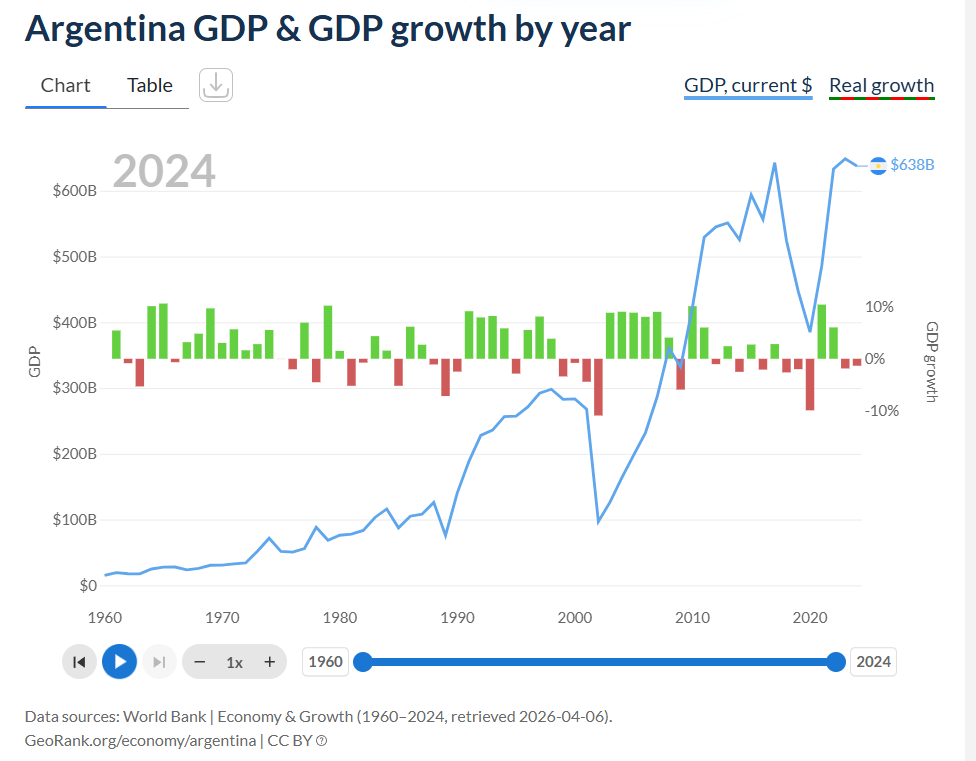
That stayed with me. After every down there was an up.
The graph above explain itself and better yet tells the story on how I bilt resillence to the contant economic changes.
The Conversation That Stayed With Me
Recently I’ve been reading a lot of posts from people in tech expressing anxiety about AI and the pace of change. Developers questioning whether their expertise will still matter. Architects exhausted from constantly reinventing themselves. Younger professionals wondering if the ladder they’re climbing will even exist in 10 years.
And honestly, I think the are right to think so.
Something has changed.
For a long time, especially in technology, there was an implicit contract: learn valuable skills, stay sharp, work hard, and you’ll probably be okay.
That agreement no longer feels guaranteed.
AI accelerated this feeling dramatically. But I don’t think AI created it alone. The industry was already under pressure: post-COVID corrections, cheap money disappearing, overhiring, shareholder expectations, global instability.
Then AI arrived and catalase the change.
The strange thing is that what many people are experiencing now feels emotionally familiar to me, even if the context is entirely different.
Not because tech workers are suddenly living through Argentine-style economic collapse. They’re not.
But because uncertainty itself changes how people relate to the future.
And perhaps that’s the part I recognise most.
Growing up in Argentina accidentally trained many of us to operate without assuming stability was permanent.
You learned to adapt because the systems changes constantly. Your currency devaluates, your government goes from right to left, rules changes.
And despite all of it, people continued building lives.
Not because they were fearless.
Because eventually they understood that waiting for certainty was not a viable strategy.
What Changed For Me
For a long time, I interpreted that background almost as a disadvantage.
Especially working in technology and enterprise environments where long-term planning, predictability, and stability are treated as signes of maturity.
But lately, I’ve started wondering if there was another side to it.
Because one thing repeated crisis teaches you sometimes unwillingly is emotional resiliency.
You become less shocked by change. And learn that instability itself can become part of the environment.
Like weather.
That doesn’t mean you enjoy it. Far from it.
But perhaps it changes your relationship with uncertainty.
And I think many people in the industry right now are experiencing profound and prolonged uncertainty for the first time in their professional lives.
That’s unsettling.
Especially when your identity is deeply tied to your proffesion.
What I’m Starting To Believe
I don’t think all the fears around AI are irrational.
Some skills will matter less and some jobs will eventually disappear. One thing is clear is that careers will change faster than people can comfortably absorb.
That part is real.
But I also think humans are far more adaptable than they realise while inside the uncertainty itself.
I’ve seen societies continue functioning through situations that, on paper, looked completely unsustainable. I’ve seen people reinvent careers, businesses, identities, entire lives multiple times.
Not perfectly. Not heroically. Just persistently.
And perhaps that’s what gives me a strange sense of optimism about this moment.
Not confidence that everything will stabilise quickly.
I don’t think it will.
But confidence that people will adapt in ways that we currently cannot yet fully see.
What This Means If You’re Feeling Behind
If you’re like me, going up and downs and feeling exhausted by the pace of change, anxious about where the industry is heading, or quietly wondering whether you still have a place in the future being built around AI, I don’t think that feeling makes us weak.
I think it makes us human.
And perhaps the goal right now is not to eliminate uncertainty entirely.
Perhaps the goal is learning how to move while uncertainty still exists.
Because waiting for the moment where everything suddenly becomes clear may not work anymore. Honestly, I’m not sure it ever did.
The people I increasingly admire are not necessarily the ones pretending to have all the answers. They’re the ones willing to continue engaging with the world even while admitting they don’t fully understand where things are going yet.
Curious enough to learn. Grounded enough not to panic. Humble enough to adapt.
That combination feels increasingly valuable to me.
And maybe if you grew up somewhere unstable, you learn something early that becomes useful later:
The future does not need to feel certain for life to remain meaningful inside it.
There’s a conversation that happens a lot in leadership circles just never out loud. It goes something like this: “I should probably engage more with this AI stuff. But what if I ask a stupid question? What if everyone else already knows this and I’m the only one who doesn’t?” So you stay quiet. You observe. You wait for the moment when you feel ready enough, informed enough, confident enough to participate. I know this, because I spent six months in the U.S. waiting for exactly that moment and it never came.
What I Thought I’d Find
Over the past six months, I had the privilege of spending time in Massachusetts and Minnesota, and attending the AI Summit in New York. I went in with a clear expectation: that somewhere in this ecosystem which in my view is the most advanced AI environment in the world, there was a level of clarity that I was missing back home. A sort of playbook. A hidden layer where the people who really understand this would finally explain how it all fits together. I had a bit of a Wizard of Oz moment in mind. I was going to peek behind the curtain and finally see who’s pulling the levers.
What I Actually Found
That didn’t happen. Yes, the U.S. is ahead in many ways. The investment is real. The infrastructure is deeper. Companies can move faster, test more, and absorb mistakes in ways that smaller markets can’t. But being ahead doesn’t mean having it figured out. What stood out was how much is still being worked through in real time. Systems don’t scale the way they were expected to. Vendors promise more than they consistently deliver. Teams explore use cases that sound brilliant in a room and quietly fall apart when they meet real constraints. And perhaps what was personally most relevant is that the people doing the most meaningful work in this space were not the ones with the most polished answers. They were the ones most comfortable saying: “I don’t know. But I’m trying this.” They were curious in a very active way. Not passive interest, real engagement. They would try tools, break them, rebuild things, change their minds, and do it again the next day. They talk about this constantly. To the point where the people around them will eventually ask to please, just once, talk about literally anything else. (That, I’d argue, happen to many of us already. A decent benchmark for genuine engagement :p) What I realised is that what we call “expertise” here is mostly just exposure. Not a hidden framework. Not a secret layer. Just time spent interacting with the problem, from different angles, over and over again.
The Conversation That Stayed With Me
Had many great conversations across this time. But one of the most valuable moments was a small setting, sitting down with someone who works closely with one of the leading consulting groups in U.S. healthcare. The topic drifted to small language models running directly on enterprise devices. Phones, laptops. Bringing AI closer to where decisions actually happen. The argument was compelling. Reduce latency. Reduce dependency on central systems. Create something more embedded in day-to-day work. I found myself pushing back, not on the idea, but on what sits underneath it. Because from an architecture perspective, especially in regulated environments, that shift isn’t just technical. It changes where control lives. When the model is no longer centralised, you lose visibility. You can’t observe interactions the same way. You can’t enforce policies as consistently. A prompt doesn’t need to come through a clean API anymore, it can come from an email, a file, a copied piece of text, and find its way back into enterprise systems in ways that are very hard to detect. What I brought to that conversation wasn’t a better model or a better tool. It was a different constraint: in some environments, especially banking, you don’t start with capability. You start with control. And whatever you build has to respect that, even if it slows things down. That perspective had value. Not because I knew more than the person across the table. This is clearly not the case because this person is brilliant. But because I came from a different environment, with different pressures, and I was willing to say what I saw. That’s the thing about real conversations: you don’t need to be the smartest person in the room to add something worth hearing.
What This Means If You’re Holding Back
I used to think of places like New Zealand as being behind in AI. Less aggressive investment, fewer large-scale experiments, a stronger tendency to wait for things to stabilise before committing. Now I see both sides. That caution reduces risk. It forces clarity. It avoids wasted effort. The trade-off is speed of learning because in this field, learning doesn’t come from reading about it or waiting for best practices to settle. It comes from doing. From trying, failing, adjusting, and trying again. And here’s what that means for you: If you’ve been waiting until you know enough to engage ( I know I was) you’re using the wrong threshold. The leaders I met who were creating the most value were not the most technically sophisticated. They were the ones willing to show up to the conversation before they had all the answers. They asked questions that others were too embarrassed to ask. They pushed back when something didn’t feel right, even without the vocabulary to explain exactly why. They brought their context, their industry, their constraints, their experience and trusted that it was enough to contribute. And let me tell you, It was enough. Every time.
The Permission You’ve Been Waiting For
There is no moment where everything suddenly becomes clear. There is no hidden layer where the real answers live. There are just people who decided to engage with the problem instead of waiting for it to resolve itself. You don’t need perfect clarity. You don’t need the full picture. You don’t need to be the most technical person in the room. You need to bring what you already have, your judgment, your experience, your willingness to ask honest questions and step into the conversation. Because the field isn’t looking for more experts. It’s looking for more people who are genuinely curious and honest about what they don’t know. That might already be you. The only question is whether you’re willing to act like it.