There’s a strange emotional feeling in the technology industry right now.
You see it in conference small talks, LinkedIn posts, Reddit threads, late-night conversations after events. It usually sounds something like this: “I don’t know if I can keep up with the constant change.”
Not because people suddenly became less capable. Quite the opposite. Many of the people I talk with that are feeling this are highly skilled, renowned professionals, deeply experienced, and have spent years building careers in environments that rewarded adaptability.
But the pace feels different now.
Every week there’s another model, another framework, another announcement explaining how entire categories of work are about to change. At the same time, companies that once looked almost invincible Microsoft, Amazon, Meta, Google are laying people off in waves that would have felt unthinkable only a few years ago.
And I think what unsettles many people isn’t just the technology itself.
It’s the feeling that the rules they trusted no longer feel stable.
I understand that feeling more than I expected to.
Perhaps because I grew up in Argentina.
What I Thought Stability Looked Like
I was born in 1986 (I am a bit vintage)
Just before me came hyperinflation. The kind my parents still talk about with a very particular tone in their voice. Supermarkets changing prices throughout the day. Salaries losing value before the month ended. People rushing to spend money immediately because waiting even a week was dangerous.
Then came the 90s.
And for a while, things felt stable. Prosperous, even.
The “1 peso = 1 dollar” years. Imported products appeared everywhere. People travelled. Consumption expanded. There was this collective feeling that perhaps Argentina had finally escaped its own cycles. For me it meaned imported toys, my first Comodoro Computer, my loved Attari, lots of fun.
As a kid, you absorb that atmosphere without fully understanding it. You just notice the emotional temperature around adults.
Optimism returned.
But so did something else.
A quiet fragility underneath it all.
Even during the “good years,” there was always conversation about the dollar at family dinners. Distrust of banks. Fear that things could turn quickly. Everyone seemed to know someone who had lost everything before.
The stability felt real and temporary.
Turns out, it was both.
What I Actually Remember
When people today describe feeling exhausted by uncertainty, I don’t interpret it as weakness.
I recognise the emotional pattern immediately.
Because I remember the mood shifts in Argentina.
General strikes. Massive layoffs. Businesses quietly disappearing. People with degrees, careers, experience suddenly unable to find work. Families reducing expenses without openly discussing why.
And small details stay with you.
I remember supermarkets occasionally running out of products. Tomatoes one week. Oil another. Never dramatic enough to collapse daily life. Just enough to create this low-level societal anxiety where everyone could feel things weren’t entirely functioning properly.
Then came 2001.
If you grew up in Argentina, you rarely need to explain “2001.” The word itself carries the atmosphere.
The protests. The bank freezes. The panic. The anger. The hopelessness.
People banging pots and pans in the streets because they no longer trusted the institutions around them to hold.
And then afterwards, something happened that I think about often lately.
Life continued.
Not immediately. Not elegantly. But it continued.
People adapted again. Small businesses reopened. Cafés filled back up. Friends still met for dinner. People still studied, started companies, fell in love, made plans, argued about politics.
The sun came out the next morning.
That stayed with me. After every down there was an up.
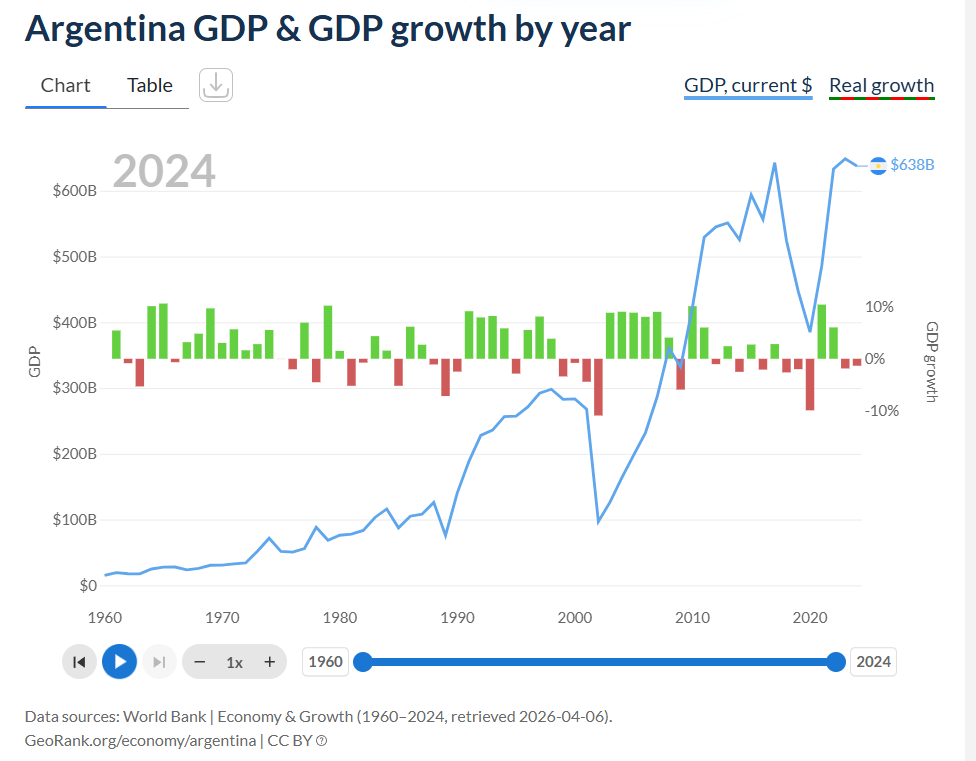
The graph above explain itself and better yet tells the story on how I bilt resillence to the contant economic changes.
The Conversation That Stayed With Me
Recently I’ve been reading a lot of posts from people in tech expressing anxiety about AI and the pace of change. Developers questioning whether their expertise will still matter. Architects exhausted from constantly reinventing themselves. Younger professionals wondering if the ladder they’re climbing will even exist in 10 years.
And honestly, I think the are right to think so.
Something has changed.
For a long time, especially in technology, there was an implicit contract:
learn valuable skills, stay sharp, work hard, and you’ll probably be okay.
That agreement no longer feels guaranteed.
AI accelerated this feeling dramatically. But I don’t think AI created it alone. The industry was already under pressure: post-COVID corrections, cheap money disappearing, overhiring, shareholder expectations, global instability.
Then AI arrived and catalase the change.
The strange thing is that what many people are experiencing now feels emotionally familiar to me, even if the context is entirely different.
Not because tech workers are suddenly living through Argentine-style economic collapse. They’re not.
But because uncertainty itself changes how people relate to the future.
And perhaps that’s the part I recognise most.
Growing up in Argentina accidentally trained many of us to operate without assuming stability was permanent.
You learned to adapt because the systems changes constantly. Your currency devaluates, your government goes from right to left, rules changes.
And despite all of it, people continued building lives.
Not because they were fearless.
Because eventually they understood that waiting for certainty was not a viable strategy.
What Changed For Me
For a long time, I interpreted that background almost as a disadvantage.
Especially working in technology and enterprise environments where long-term planning, predictability, and stability are treated as signes of maturity.
But lately, I’ve started wondering if there was another side to it.
Because one thing repeated crisis teaches you sometimes unwillingly is emotional resiliency.
You become less shocked by change. And learn that instability itself can become part of the environment.
Like weather.
That doesn’t mean you enjoy it. Far from it.
But perhaps it changes your relationship with uncertainty.
And I think many people in the industry right now are experiencing profound and prolonged uncertainty for the first time in their professional lives.
That’s unsettling.
Especially when your identity is deeply tied to your proffesion.
What I’m Starting To Believe
I don’t think all the fears around AI are irrational.
Some skills will matter less and some jobs will eventually disappear.
One thing is clear is that careers will change faster than people can comfortably absorb.
That part is real.
But I also think humans are far more adaptable than they realise while inside the uncertainty itself.
I’ve seen societies continue functioning through situations that, on paper, looked completely unsustainable. I’ve seen people reinvent careers, businesses, identities, entire lives multiple times.
Not perfectly.
Not heroically.
Just persistently.
And perhaps that’s what gives me a strange sense of optimism about this moment.
Not confidence that everything will stabilise quickly.
I don’t think it will.
But confidence that people will adapt in ways that we currently cannot yet fully see.
What This Means If You’re Feeling Behind
If you’re like me, going up and downs and feeling exhausted by the pace of change, anxious about where the industry is heading, or quietly wondering whether you still have a place in the future being built around AI, I don’t think that feeling makes us weak.
I think it makes us human.
And perhaps the goal right now is not to eliminate uncertainty entirely.
Perhaps the goal is learning how to move while uncertainty still exists.
Because waiting for the moment where everything suddenly becomes clear may not work anymore.
Honestly, I’m not sure it ever did.
The people I increasingly admire are not necessarily the ones pretending to have all the answers. They’re the ones willing to continue engaging with the world even while admitting they don’t fully understand where things are going yet.
Curious enough to learn.
Grounded enough not to panic.
Humble enough to adapt.
That combination feels increasingly valuable to me.
And maybe if you grew up somewhere unstable, you learn something early that becomes useful later:
The future does not need to feel certain for life to remain meaningful inside it.
Thanks for reading.